The Cosmic Library - the Olivier Time Entanglement Theory Explanation
The Cosmic Library: Reimagining the Block Universe Through the Architecture of the Time Entanglement Theory
(copyright March 9, 2026)
What I know about quantum physics could fit inside a very small thimble.
But I have always been driven by ideas and a deep curiosity. If you are a physicist who can teach me something new or correct my trajectory, I welcome you to reach out. If you aren't familiar with quantum mechanics, now is the time to start asking questions. We are less than a decade away from a world dominated by quantum computing, and when it arrives, it will change absolutely everything.
To some, this theory will seem inconceivable. To others, obvious. My hope in sharing these thoughts is to spark a meaningful dialogue that pushes our collective understanding forward.
Most of us move through life within the comfortable boundaries of a three-dimensional world. We perceive, act, and understand reality through ordinary, day-to-day experiences. Yet, there are rare moments when the mind catches a glimpse of a much larger architecture—an unexpected look at a deeper reality. Once you see it, it is impossible not to try and make sense of it.
My background is in engineering, though I have spent the last 36 years practicing law. While I don't claim to be a genius, a life spent working alongside incredibly sharp minds has pushed me to articulate a concept that I believe offers a fresh perspective on quantum entanglement.
A Note on Collaboration: In the spirit of transparency, I want to acknowledge that I used the large language model Gemini as a sounding board to help organize and refine these ideas. While its assistance was invaluable for editing and structuring, the underlying theory, its core insights, and the central arguments are entirely my own original work.
Traditional models of spacetime often suffer from a massive disconnect: they struggle to bridge cold mathematical abstraction with physical, human reality. Einsteinian relativity establishes that the past, present, and future are equally real inside a four-dimensional "block universe," yet our lived experience remains stubbornly linear and fleeting.
The Time Entanglement Theory bridges this gap. By looking at the universe through the lens of entangled particles, localized wave boundaries, and higher-dimensional geometry, this theory proposes that every single instant of existence is captured as an immutable, three-dimensional "flash photo." These snapshots never vanish. Instead, they occupy permanent coordinates along a fourth-dimensional axis, forming an infinite universal library. Within this framework, entanglement is simply a shared participation in the exact same wave crest of reality, offering a tangible, mechanical explanation for how spacetime is structured.
I. The Foundational Physics: Einstein, Minkowski, and the Reality of Yesterday
To understand how a moment can be permanently preserved, we have to look past the classical Newtonian view of time. Isaac Newton envisioned time as an absolute cosmic clock ticking uniformly across the universe, completely independent of space or matter. In his view, "now" was a universal constant. Albert Einstein shattered this concept by proving that while the speed of light is absolute, space and time are entirely relative. Because light travels at a constant speed, space and time must dynamically stretch and compress depending on how fast an observer is moving.
The Illusion of Simultaneity
The most profound consequence of this is the relativity of simultaneity. Two events that happen at the exact same time to you might happen at completely different times to someone moving at a different speed. There is no single, objective "present moment" for the universe. If your "now" depends entirely on your speed and location, then one person's past is another's present, and someone else's future. For these differing perspectives to coexist without logical contradictions, the past, present, and future must all possess the exact same degree of physical reality.
The Infinite Telescope
We can ground this relativistic truth with a simple thought experiment: the Infinite Telescope. Imagine an observer on a planet exactly 60 light-years away from Earth, looking at us through an incredibly powerful lens. Because light takes precisely 60 years to travel that massive distance, the data hitting their telescope today doesn't show the Earth of 2026. Instead, it carries the complete, live physical data of Earth from 1966. If that observer looks at you, they don't see an adult; they see a child playing in a yard. This isn't a delayed broadcast or a recording; it is the active reception of live light waves carrying the physical signature of that exact historical moment. For them, your childhood is happening right now. If that past moment had truly ceased to exist, there would be no physical photons left for the telescope to collect. In this example our past is not gone; it is actively traveling through the cosmos, perfectly preserved as a structural component of the universe.
II. The Philosophical Bedrock: Presentism vs. Eternalism
Where physics ends, philosophy inevitably begins. In the philosophy of time, thinkers have long been divided into two major camps: Presentism and Eternalism.
Presentism: The Common-Sense Illusion
Presentism is our default human worldview. It claims that only the immediate present exists. The past is treated as a collection of psychological ghosts and memories that no longer have physical substance, while the future is an unformed void. While Presentism matches our day-to-day human experience, it fails entirely when confronted with modern physics. Because relativity proves there is no unique, objective "now" for the entire universe, Presentism creates an impossible paradox: if only the present exists, but everyone’s present is different, whose present is the real one?
Eternalism and the Block Universe
The alternative is Eternalism—the view that all points in time are equally real. Just as New York, London, and Tokyo all exist simultaneously in space even if you aren't standing in them, yesterday, today, and tomorrow all exist simultaneously in the time dimension. When you map Eternalism onto a four-dimensional matrix, you get the Block Universe model. It views the cosmos as a rigid block where objects are not temporary 3D shapes, but permanent 4D "world-lines" carved through time. A human being is not just a body existing right now; they are a continuous, four-dimensional physical structure stretching from birth to death.
The Time Entanglement Theory embraces Eternalism but solves its greatest vulnerability. Standard Eternalism treats the universe as a cold, abstract mathematical grid. It fails to give us a graspable, mechanical explanation of how these moments are structured and why matter looks the way it does at any given instant. This theory provides that missing piece by introducing the concept of the universal "flash photo."
III. The Core Mechanics: Waves and Moving Posts
To move past abstract mathematics, we need a mechanical model of how a single slice of time is actually constructed, starting at the quantum level and scaling up to the world we can see.
The Time Wave
The foundational spark of this theory relies on the behavior of entangled photons—particles created at the exact same micro-moment from a single quantum event. Their states remain intrinsically linked regardless of the physical distance separating them. As these photons radiate outward, they don't just travel through an empty vacuum. Their simultaneous creation and outward journey establish a permanent, radiating time wave-front. This theory suggests that time itself propagates in a similar way. To a four-dimensional observer, time doesn't "flow" sequentially; everything exists at once. We simply experience micro-slices of this grand structure one frame at a time. To visualize this, imagine a room with a light controlled by a highly sensitive dimmer switch. As the switch fluctuates, the intensity of the light in the room constantly shifts. This rhythmic, continuous variation is analogous to the wave of time moving through our environment. Every infinitesimal change in intensity marks a distinct, subsequent interval of existence.
The Analogy of the Moving Posts
To understand how this continuous time wave interacts with matter, imagine a pier with vertical posts driven into the seabed, with ocean waves rolling through them. Now, imagine that these posts are not static—they are actively moving, twisting, turning, and tilting at precise angles. Dynamically, this looks like a chaotic, fluid environment. But if we freeze the system at an absolute micro-second, a precise physical record is locked into place:
- The Physical Mark: At that exact micro-second, the water strikes each moving post at a highly specific, measurable height, leaving a literal physical mark.
- The Vector Metrics: The water molecules possess a precise, unalterable velocity vector, and each post is frozen at its exact coordinate and angle of tilt.
- The Static Document: Every single variable is completely locked.
This is exactly how a slice of time works. It isn't an abstract concept; it is defined by the total, simultaneous configuration of all matter at one precise point along the time wave. What appears to us as a moving wave is actually a permanent, bound crest when viewed from a higher dimension.
IV. The Dimensional Shift: 3D Brains vs. 4D Reality
The primary reason we struggle to grasp the permanence of the past comes down to the evolutionary limits of the human brain. We evolved to navigate a three-dimensional spatial environment, processing sensory input sequentially just to survive. We experience reality through a narrow aperture, viewing the slices of time one by one. This creates the illusion of temporal passage—a sensation very much like watching a film, where individual, static frames are projected in rapid succession to simulate motion. Once the cosmic "flash photo" occurs, that specific configuration of matter never dissolves. It remains anchored as a permanent, unchanging page bound forever into a universal book. Because a single slice of time extends infinitely across the universe, particles created together remain entangled because they are riding the exact same wave crest on the exact same page.
Measurement simply interrupts this relation. When we measure a particle, we pull it out of its pristine connection to the infinite wave and force it into a definite, local condition. In essence, observation doesn't create entanglement; it draws a boundary around it.
V. The Concept of the Cosmic Librarian
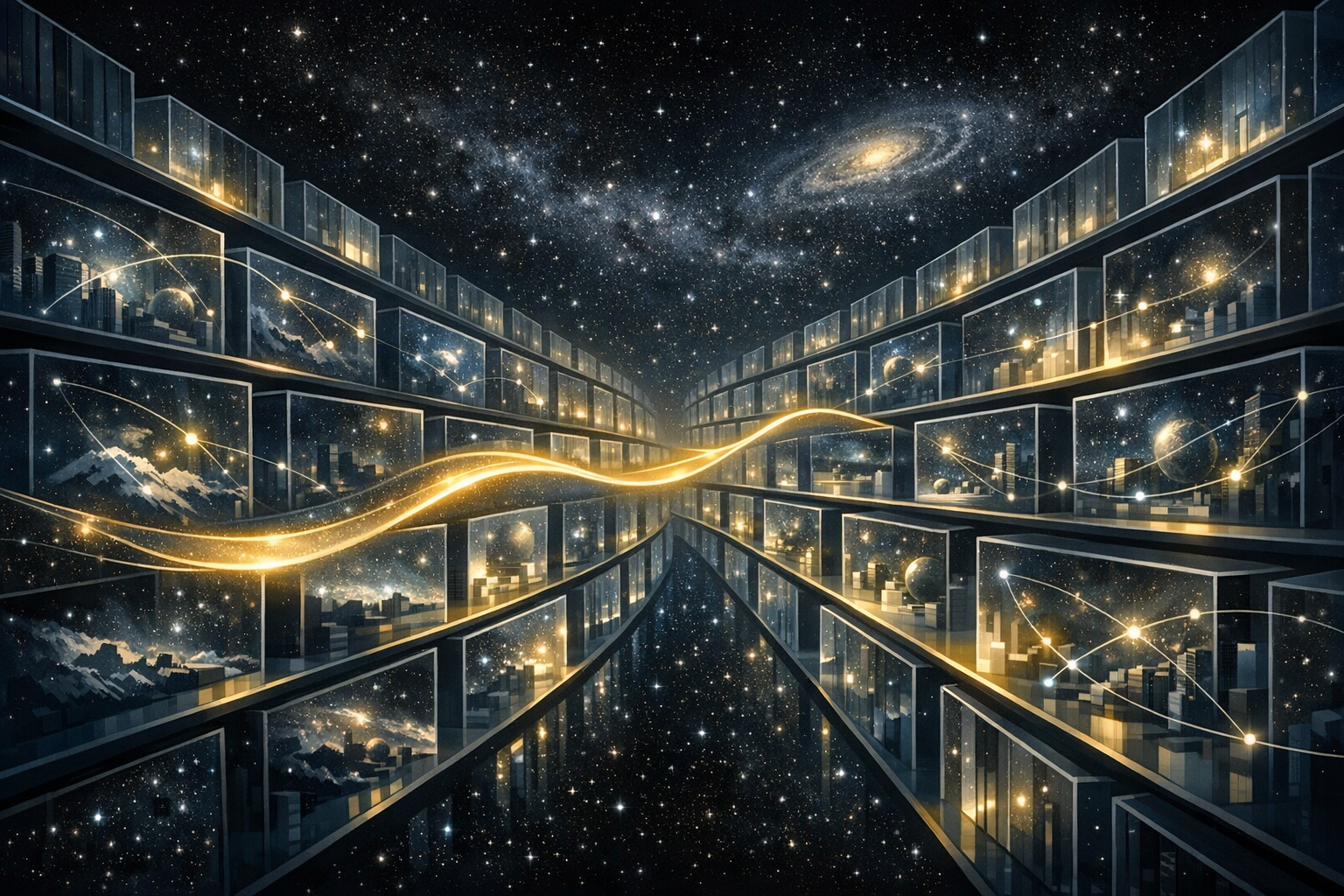
To fully conceptualize this framework, it helps to introduce an ultimate theoretical observer: The Cosmic Librarian. The Librarian operates entirely outside the constraints of our sequential human perception. We cannot physically flip back to a previous page of our lives, nor can we jump ahead. The Librarian, however, occupies a higher-dimensional vantage point where the entire library is open all at once:
- The Librarian doesn't wait for the dimmer switch to turn up or down; they see the entire spectrum of light co-existing simultaneously.
- They don't see the water hit a post and flow away; they see an endless, static sequence of posts, each permanently frozen with its unique water line, laid out side-by-side on a shelf.
- They perceive the birth of a star, the construction of the pyramids, your daily walk to work, and the final cooling of the cosmos as a single, co-existing masterpiece.
This perspective clarifies that our inability to access the past is not a property of the universe itself, but a limitation of our current coordinates. The page containing yesterday has not been torn out or burned; it simply sits a fraction of a millimeter away along the four-dimensional axis, perfectly preserved for eternity.
VI. Why the Name Matters: Universal Entanglement
This framework has a vital distinction from standard physics. While it aligns with the philosophy of Eternalism, it introduces a wholly new mechanical approach:
Time Entanglement. In classical physics, a point in spacetime is treated as an isolated coordinate—a lonely dot on a grid. This theory rejects that isolation. Because every time slice is anchored to a shared, universal wave crest, it implies that
every point within a single three-dimensional slice is intrinsically entangled with every other point in that same slice.
When the cosmic flash photo occurs, the freezing of matter is not a fragmented, localized event. The precise height of a wave against a post in a local harbor is quantum-mechanically linked to the position of a particle on the opposite side of the planet. They are bound together by the permanent wave crest of that specific moment. This universal entanglement is what ensures the perfect, cohesive synchronization of each "page." The universe cannot experience a glitch or a partial frame rate; it freezes completely, universally, and symmetrically.
VII. Looking Forward: Implications for Modern Physics
While the Time Entanglement Theory provides an intuitive model for the human mind, it also introduces provocative answers to some of the greatest crises in modern physics.
Resolving the Paradox
A major paradox in modern physics centers on black holes. Quantum mechanics states that physical information about the state of matter can never be destroyed (dU/dt=0). However, general relativity suggests that when matter falls into a black hole, its information is permanently erased when the black hole evaporates. The Time Entanglement Theory offers a clean, structural solution. If every moment of time exists as a permanent, immutable three-dimensional slice along a four-dimensional axis, then information is never truly lost. Even if an object is crushed into a singularity on a later page, its intact, uncrushed configuration remains perfectly preserved on the previous pages of the universal library.
The Mechanics of Gravity
In general relativity, gravity is modeled as the warping of spacetime caused by mass and energy—a heavy planet creates a dip in the fabric of the four-dimensional block. This theory clarifies how this occurs mechanically. Because each page is a static snapshot of matter with precise positions and velocity vectors, the "warp" is actually the geometric alignment of successive pages. Gravity is not a dynamic force pulling on matter over time; it is the structural, sequential stacking of these three-dimensional pages, carved out in perfect harmony across the permanent wave crests.
VIII. Conclusion: The Endurance of Everything
The Time Entanglement Theory completely reshapes our relationship with reality. It asks us to abandon the bleak, unscientific notion that our lives are written on a chalkboard, constantly wiped clean by the eraser of passing time. Instead, it proves that the universe is a grand, unyielding repository of architectural perfection. Every word you have ever spoken, every wave that has ever crashed against a shoreline, every tear that has fallen, and every smile that has ever illuminated a room is locked into an eternal, three-dimensional masterpiece.
We are not fragile biological organisms rushing toward non-existence. We are four-dimensional structures carved permanently into the fabric of creation. We cannot see our past for the same reason we cannot see the city behind us when driving down a highway—not because the city has ceased to exist, but simply because we have moved further down the road.
The library is vast, the shelves are infinite, and every single page remains bound in place forever. The past is not a memory; it is an enduring monument. Before, now, and forever.

Recent Posts