Do you like cake? Good. Because if you do, I can explain Bitcoin to you in about two minutes—no finance degree or painful jargon required.
Skip the tech-talk. Let’s look at how this works using bakeries.
1. Money: The Two Flavors
Before the bakeries, let’s define our money for this example. It's just stuff we agree to trade, and it comes in two types:
• Fiat Money (Vanilla): The US dollar. It has value because the government says so.
• Non-Fiat Money (Chocolate): This is crypto. It has no government backing. Its value is entirely decided by what people are willing to pay for on the open market.
2. Welcome to the Bakery
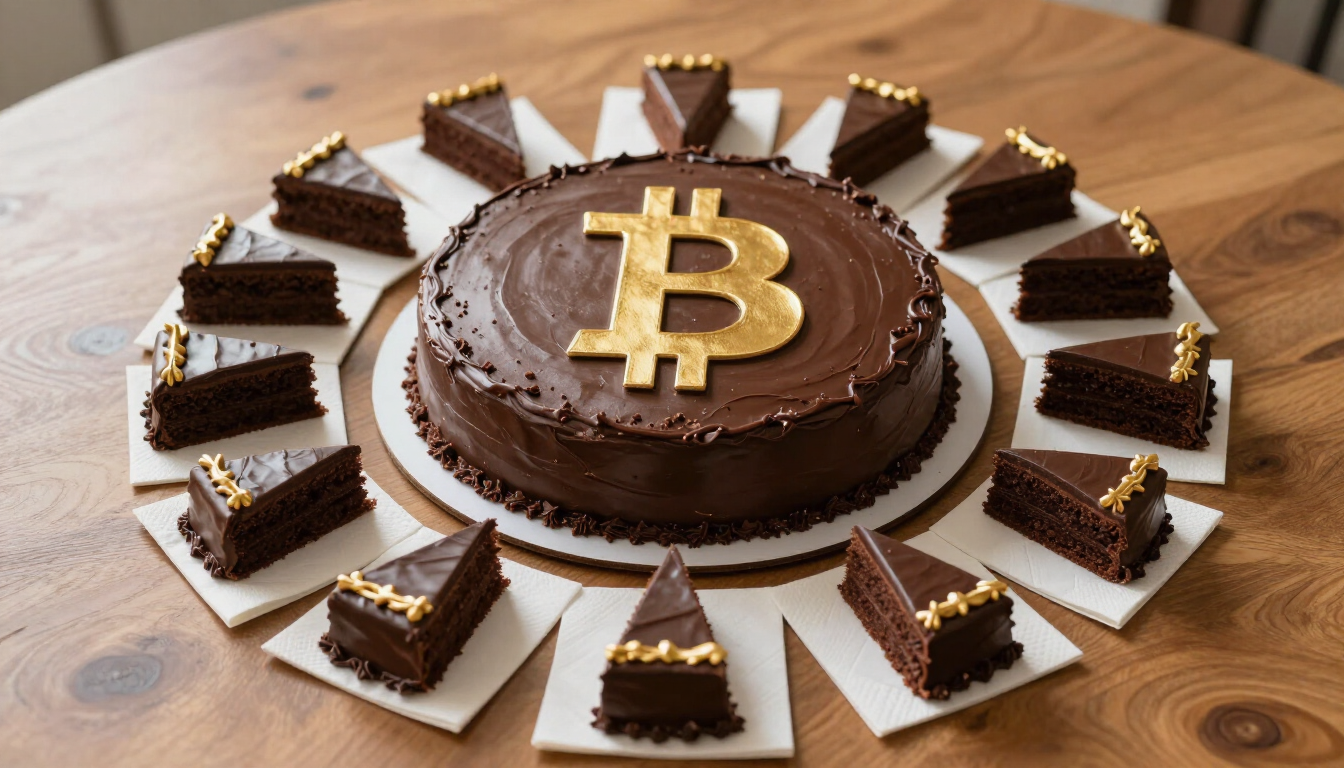
Picture the crypto market as a board game called CryptoVille, a busy little town where we trade chocolate cake instead of cash. The most famous shop in CryptoVille is the Bitcoin Bakery. Let's say each day one cake is made, and a single Bitcoin cake is worth $70,000. You don't buy the whole thing, you buy a itty bitty slice. You pay your money, and you get a receipt proving you own that sliver. Here’s the catch: you never actually eat the cake. It just sits there. You hold your receipt and hope someone else will want to buy your sliver for more than you paid.
3. The Locked Cake Storage Boxes (The Blockchain)
When you buy your sliver, it goes into a clear glass box with a hundred thousand other people's slivers, all tracked by their receipts. Once that box is completely full, it gets wrapped tight with a heavy-duty security ribbon and locked. Then, a new box starts filling up right next to it. Those boxes are blocks. That long, unbroken line of locked, linked boxes is the blockchain. The "ribbon" is encryption. To untie it without the key would take an impossible amount of computer power. Even if you broke in, without the matching receipts, the cake inside is useless to you.
4. Why It's Safe (or not just safe)
This chain of blocks is decentralized, In the Old West there were “centralized” banks. To rob it you rode up on your horse with your questionable peer groups, and took $10,000 from that one safe by force. In a decentralized world, to get that $10,000 you would have to find the 10,000 locations and collect the one dollar held in each location. Decentralized bank dollars are scattered across the globe and only each owner knows where there dollar is. I am not riding my horse to find that money!
Okay, now the paragraph title makes more sense..
5. The Takeaway
The value of these cakes goes up and down every day, based on hype, what’s going on in fiat money and pure demand.
Should you buy a slice? If you're curious, why not. The two most widely recognized bakery cakes are BitCoin and Ethereum. But remember that the crypto market moves fast. Only spend what you're genuinely okay losing and keep an eye on the bakery prices!
More questions? DM me here or email me from my website.